
Why Enugu?
The Inevitable Birthplace of Preemptology
Enugu has shaped the future of preventive science, producing world-firsts in vaccines, diagnostics, surgery, disease eradication, and community-driven public health. From smallpox to river blindness, from cholera to COVID-19, its innovations share a single logic: anticipation over reaction. Preemptology does not arrive here to begin something new; it arrives to continue a legacy already in motion.
Enugu is the quiet engine room of African scientific imagination—a city whose contributions to global health have repeatedly reshaped human wellbeing. To understand why the Institute of Preemptology belongs here, one must understand what Enugu has already given the world.
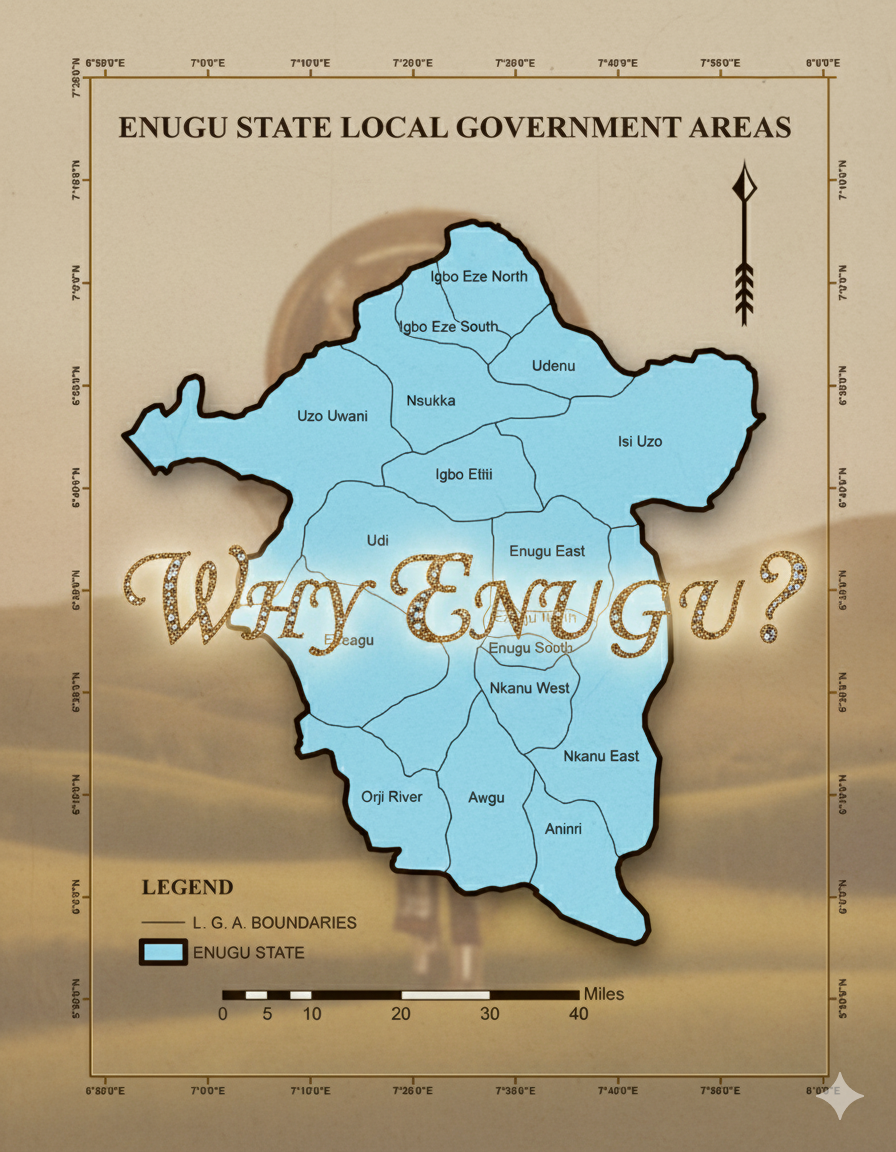
From Enugu came the first African to invent an industry-standard pharmaceutical drug—an innovation that produced a cholera vaccine deployed to abort one of the worst cholera epidemics in Northern Nigeria. It is the same intellectual soil that nurtured the first African to independently identify a new disease, now globally recognised as CTE, reshaping understanding of neurodegeneration.
From Enugu also emerged solutions designed not for ideal conditions, but for real-world constraints: the world’s first non-blood malaria test, transforming diagnosis in resource-limited settings; and the scientist who mapped African paragonimiasis using non-invasive diagnostics.
Enugu’s tradition of surgical innovation is equally profound. From its intellectual ecosystem emerged the surgeon who performed the world’s first single-stage delayed autologous structural rib reconstruction—an achievement that expanded the boundaries of reconstructive surgery—and the visionary who created the intra-operative tumour-visualisation technology known as the “cancer goggle,” enabling surgeons to see what the naked eye cannot.
Beyond laboratories and operating theatres, Enugu reshaped the architecture of global public health. Community-Directed Treatment (CDT), conceived and refined here, placed agency, foresight, and prevention directly in the hands of affected populations. CDT became a cornerstone of global public health, contributing to a 90% reduction in river blindness and the near-eradication of Guinea worm.
Enugu consistently produces thinkers who do not merely respond to disease—they anticipate and outmanoeuvre it. Its scientific culture is defined by foresight, community partnership, and a relentless commitment to solutions that work at scale.
The launch of the Institute of Preemptology in 2026 formalises and renews an African-rooted legacy that has already defined the outer limits of global health achievement, affirming Enugu as the birthplace, benchmark, and enduring acme of humanity’s preemptive imagination.
Preemptology will be the crowning acme of Enugu’s contribution to global health. Here, Preemptology is not an invention. It is a continuation.