
The Institute of Preemptology · Our Story
How Preemptology Was Born.
Three decades in the field. Thousands of patient encounters.
One structural insight that changed everything.
I · Witness
What three decades of medical practice revealed
For three decades, across clinical practice in Africa, the Americas, and Asia — spanning local government primary care, missionary institutions, private clinics, and national and tertiary hospitals — the physicians, surgeons, and global health stewards who established mass medical mission two decades ago encountered the same pattern of preventable loss.
Year after year, they witnessed patients arriving at late stages of diseases that routine screening could have detected earlier. Mothers lost children to illnesses for which timely intervention already existed. Communities lacked access to screening, pathways for early detection, structured health education, and integrated preventive healthcare systems operating at the community level.
Healthcare was, in most settings, primarily reactive. The system waited for people to become ill. By the time they reached care, it was often too late. Some of these experiences predated the founding of mass medical mission; others followed it. Together, they formed a continuous body of evidence.
One of the earliest and most defining moments occurred years before m3 was founded, at a missionary hospital in the South Western Zone of Nigeria.
"The memory of New Year's Day 2002 has never left me. A widow was rushed to the emergency room by her frightened daughters, bleeding from terminal cervical cancer — a disease that is 100% preventable. There had been earlier opportunities to screen her. None had been taken. The absence of a preemptive health system had failed her. The era of reactive medicine must end."Dr Abia Nzelu
II · Field Experience
Going where the health system did not
Through nationwide community outreaches and sustained media campaigns, mass medical mission carried preventive care into settings the formal health system had long left behind. The programme did not wait for communities to come to hospitals. It went to them.
Outreaches were conducted wherever people gathered — not only in clinics and health posts, but in the full range of environments where underserved Nigerians lived and worked.
- Rural villages
- Prisons
- Mosques
- Churches
- Military barracks
- Corporate campuses
- Underserved urban communities
- Faith communities
The pattern that emerged across every setting was consistent. When quality preventive care was brought directly to communities, people came. Geography and cost were the barriers. The willingness was always there.

III · Proof in the Field
Nigeria's first Integrated Mobile Health System
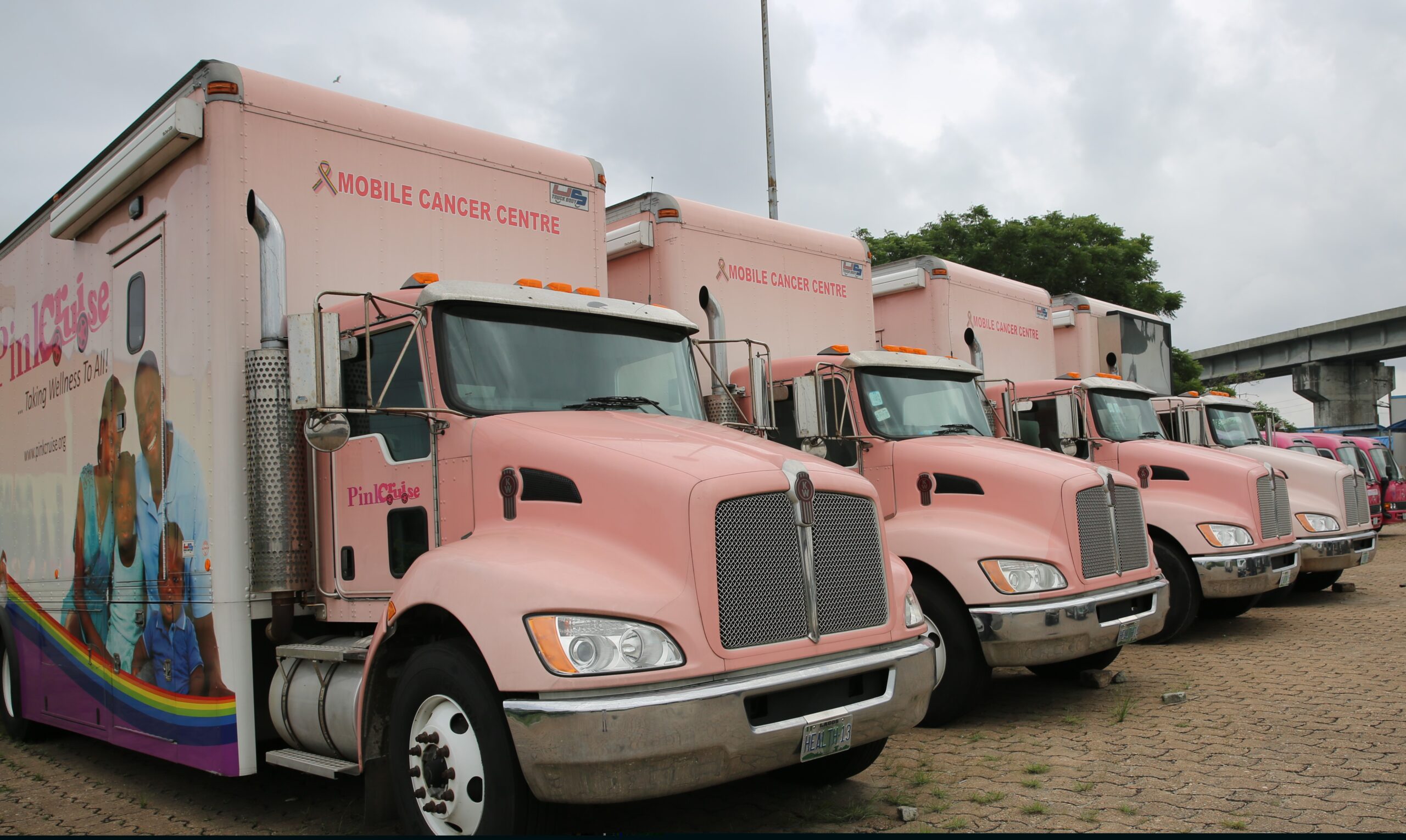
In 2017, mass medical mission achieved a defining operational milestone: the deployment of Nigeria's first Integrated Mobile Health Units. The centrepiece was the PinkCruise fleet — state-of-the-art vehicles sourced from the United States and equipped to deliver a comprehensive range of diagnostic and therapeutic services in a single visit, at the point of community need.
The PinkCruise operated alongside the PinkVISSION Mobile Eye Centre and the PinkDentist Mobile Dental Centre — together forming an integrated mobile health system capable of delivering multi-specialty preventive care in a single community engagement.
These programmes did not merely extend the reach of existing services. They became a living laboratory for preventive medicine at scale — producing operational evidence that would eventually reframe how the founders understood the structural problem in global health.
IV · Empirical Validation
The data confirmed what the field had already shown
A 2020 operational analysis of more than 9,000 programme beneficiaries provided rigorous empirical grounding for what years of outreach experience had suggested.
Participants initially presented at the outreach site for varied, specific reasons:

V · Founding Insight
The Missing
Discipline
After two decades of field experience and thousands of patient encounters, a deeper realisation emerged — one that went beyond the logistics of outreach or the scale of mobile fleets.
The global health system had never institutionalised prevention as a medical discipline. Prevention existed in policy documents and public health strategy, but it lacked ownership in clinical practice. No physician specialty was primarily accountable for preempting disease across the life course. In practice, prevention was crowded out: urgent clinical demands consumed the attention of overburdened physicians, while community health workers remained chronically under-resourced and overstretched. Accountability for disease not occurring was diffuse, collective, and ultimately absent.
The result was a system architecturally designed to respond to illness — not to prevent it. And incremental improvements to that architecture could not resolve the structural gap.
The Institute of Preemptology was created to fill that structural gap — to establish prevention not as a programme, but as a profession.
VI · Institutional Response
From mass medical mission
to the Institute of Preemptology
The Institute of Preemptology did not emerge as a theoretical idea. It is the institutional evolution of a model that was proven in practice — two decades of field operations, an empirically validated programme, and a clear recognition of a structural gap that no existing medical discipline had been built to address.
The transition from mass medical mission to the IoP was not a departure from the mission. It was its logical conclusion. The field experience had established what was possible. What remained was to build the institutional infrastructure capable of making it permanent, scalable, and globally accountable.
The Institute exists to train a new class of physician — the Preemptologist — whose primary mandate is to preempt disease across the life course, and to organise the delivery of proactive care at population scale. It exists to transform reactive healthcare systems into preemptive ones. And it exists because two decades of evidence on the ground made the case that this transformation is not only necessary, but achievable.
The lived experience of those outreaches — every patient reached, every life extended, and every life lost to a system that arrived too late — is the ground on which the Institute stands. Preemptology did not emerge from a hypothesis. It was summoned by evidence, and by a gap in medicine that had gone unnamed for too long.
For a fuller visual chronicle of the programme's evolution, see the milestones archive of mass medical mission.